
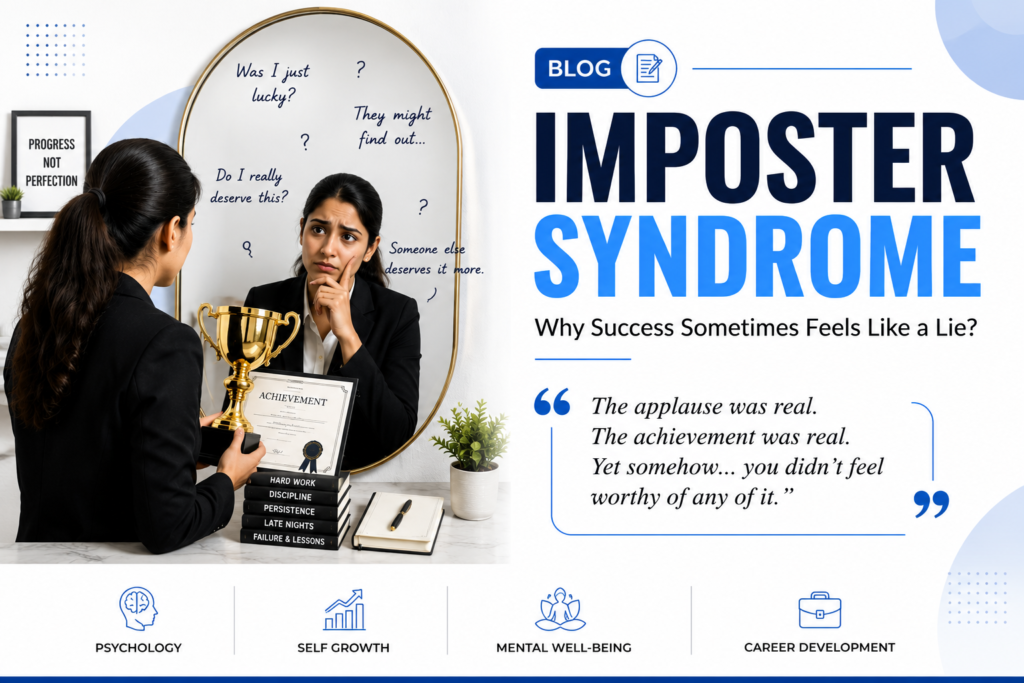
Imagine standing on a brightly lit stage.
Your name echoes through the auditorium.
The audience rises to their feet.
Your parents are smiling with pride.
Teachers applaud.
Your friends cheering you up as you walk towards the podium.
A shining trophy is placed in your hands.
For everyone in that room..
You are the symbol of hard work.
Symbol of resilience.
Yet while hundreds of people in the auditorium are celebrating you ..
Bubble of thoughts surround you and your mind whispers,
“They have made a mistake.”
“Someone else may deserve it more than I deserve it.”
The applause is real.
The trophy is real.
The achievement is real.
Yet somehow…
You don’t feel worthy of any of it.
That evening …
You return home.
You place the trophy on your desk.
You walk towards the mirror.
And something strange happens.
The audience saw a winner.
The mirror shows someone who feels ordinary.
The world sees years of hard work.
The mirror reflects only the mistakes you made along the way.
The world celebrates your achievement.
The mirror quietly asks,
“Did you really deserve it?”
How strange…
The reflection is yours.
But the person looking back feels like someone who doesn’t belong.
“There are two mirrors in life. One is held by the world, reflecting your achievements.
The other is held by your mind, reflecting only your doubts.”
If this feeling sounds familiar…
You are not alone.
Millions of students….
Professionals…
Entrepreneurs ….
Researchers ….
Artists….
And even some of the world’s most successful people have quietly wondered,
“What if everyone discovers I’m not capable as they think I am?”
Psychology has a name for this invisible struggle.
It’s called Imposter Syndrome.
The strange thing is …
The mirror never questioned your success.
It never called you a failure.
It never told you that you didn’t deserve the trophy.
Your mind did.
And perhaps…
That’s what makes Imposter Syndrome so dangerous.
It doesn’t steal your achievements.
It steals your ability to believe them.
What exactly is Imposter Syndrome?
Imposter Syndrome is a psychological experience in which people constantly doubt their own abilities and secretly fear that one day they’ll be exposed as less capable than everyone believes.
In simple words…
No matter how many achievements they have,
Their mind constantly reminds them,
“You don’t belong here.”
Ironically…
This feeling is most common among people who are actually highly capable.
Instead of accepting their achievements,
They keep on explaining
“I was just lucky.”
“The exam was easy.”
“Anyone could’ve achieved it.”
Success becomes luck.
Failure becomes proof.
Why Does Our Brain Think This Way?
If you’ve ever experienced Imposter Syndrome, you might wonder…
“Why does my mind refuse to believe something that everyone else can clearly see?”
The answer is not that you are incapable.
It’s that your brain judges you by a different standard bar than it judges everyone else.
Imagine a situation where you have given a presentation.
Everyone in the room is applauding and appreciating.
But still you’re stuck and not remembering the loud applause..
And you are stuck and replaying the mistake you made…
You forgot one line and you stumbled there.
So, one small mistake become more louder than twenty minutes of confidence where you carried the presentation with lot of confidence.
Why?
Because our brains are naturally wired to notice imperfections.
The Story Behind Imposter Syndrome
“Some battles are so common that psychologists eventually decide to ask a simple question: ‘Why do so many successful people feel like frauds?”
In the late 1970s, psychologists Dr. Pauline Rose Clance and Dr. Suzanne Imes noticed something that didn’t make sense.
Many of the people they worked with were exceptionally talented.
They had earned degrees from prestigious universities.
Built successful careers.
Received recognition for their work.
Yet despite all these achievements..
They carried a quiet fear.
A fear that one day someone would discover they weren’t capable as everyone believed.
For the outside world, they looked confident.
Inside, they felt like they were pretending.
In 1978, Clance and Imes described this experience as the Impostor Phenomenon, a term that later became widely known as Impostor Syndrome.
At first, they believed it mainly affected high-achieving women.
However, decades of research revealed something much bigger.
Impostor Syndrome doesn’t discriminate.
Even some of the world’s most admired leaders have admitted to feeling like they didn’t deserve their success.
Perhaps the most surprising truth is this:
Impostor Syndrome isn’t a sign that you’re incapable. It’s often a sign that you care deeply about doing well.
Where Does It Hide?
“Imposter Syndrome rarely announces itself. It quietly hides behind our everyday thoughts.”
Most of us imagine self-doubt as something dramatic.
In reality…
It often sounds surprisingly ordinary.
It not only happens in professional life it also happens in personal life.
- In relationships:
Love isn’t about being accepted by someone else.
It’s about believing you deserve to be loved.
Imagine you are in a relationship and your partner genuinely loves you.
They admire your kindness.
They appreciate your efforts.
They keep you as their priority every single day.
Yet somehow deep inside, a quiet voice always keeps on whispering,
“One day my partner will realise I am not good enough.”
“They deserve someone better than me.”
The relationship is healthy.
The love is real.
Yet imposter syndrome convinces you that you are only loved by your partner because they have not discovered your flaws yet.
“The saddest part of Imposter Syndrome is that even genuine love begins to feel borrowed, as though one day it will have to be returned.”
- Chasing Dreams:
Sometimes, Imposter Syndrome gives us a visit the moment our dreams begin coming true.
We start questioning all our achievements and start doubting our abilities.
Ironically ..
The opportunities we worked hard for and manifested the most are the ones where we doubt ourselves the most.
Breaking Free
The only way to overcome imposter syndrome is self-acceptance.
Imagine a situation where your friend cracked a job interview for which he was preparing for months.
So, will you call your friend lucky or call them hardworking?
The answer is obvious.
We often serve kindness to others and forget to serve it with a silver spoon to ourselves.
Imposter syndrome can’t be reversed overnight.
And if you are thinking it will be reversed if someone comes and tell you
“Oh!! You’re good enough.”
It begins the day you decide to believe yourself.
Celebrate your efforts.
Accept compliments before doubting them.
Allow yourself to start from beginning.
Never hesitate to ask questions because the person who seems to be perfect now was also a learner one day.
It shows your growth, your positive mindset towards learning.
Sometimes knowing everything is not an achievement. But showing up anyway is an achievement.
The Reflection We Choose To Believe
“The mirror never decides our worth. It only reflects the story that you choose for yourself.”
Remember the mirror?
It never ever questioned your success.
It never called you a failure.
It never whispered that you don’t belong here.
Those words came out of your soul.
From years of comparison.
The continuous chase behind perfectionism.
Constant fear of failure.
And the expectations you quietly carried on your shoulders.
One day..
You’ll stand in front of that same mirror again.
The awards will still be yours.
The late nights will still happen.
The failures will be still part of your journey.
But maybe..
For the first time you will feel…
The confidence in finding your true self back.
You will see the mirror with eyes wide open.
Your strengths.
Your flaws.
Your mistakes.
And still applaud the loudest for yourself.
The applause was never asking you to become perfect.
It was simply acknowledging the journey nobody else saw.
And that will be the moment you will realise
“The applause was never meant to convince the world that you deserved success. It was meant to remind you. The only standing ovation you’ve been waiting for…is the one from the person in the mirror.”
This vlog is a powerful reminder that self-doubt doesn’t define our abilities. Thank you for explaining imposter syndrome so clearly and encouraging us to believe in our own journey.
Well done ✅
This really spoke to me. The way you described imposter syndrome felt so real and honest—it’s something so many of us go through but rarely talk about. Reading this was a reminder that self-doubt doesn’t erase our hard work or our achievements. Thank you for putting these feelings into words so beautifully. Keep writing—you have a way of making people feel seen, and that’s a gift. ❤️
Exactly true 💯, to overcome fear factor we can win any battle in life
👏🏻👏🏻👍🏻👍🏻
👏👏
Good work
👏👏
Excellent
Keep it up…!
Keep it up !🙌👏👏
Amazing
Mehak you have explained this term with so much efficiency and clarity.Proud of you 👍🏻
Very well explained.Keep it up.
Amazing 👏👏