
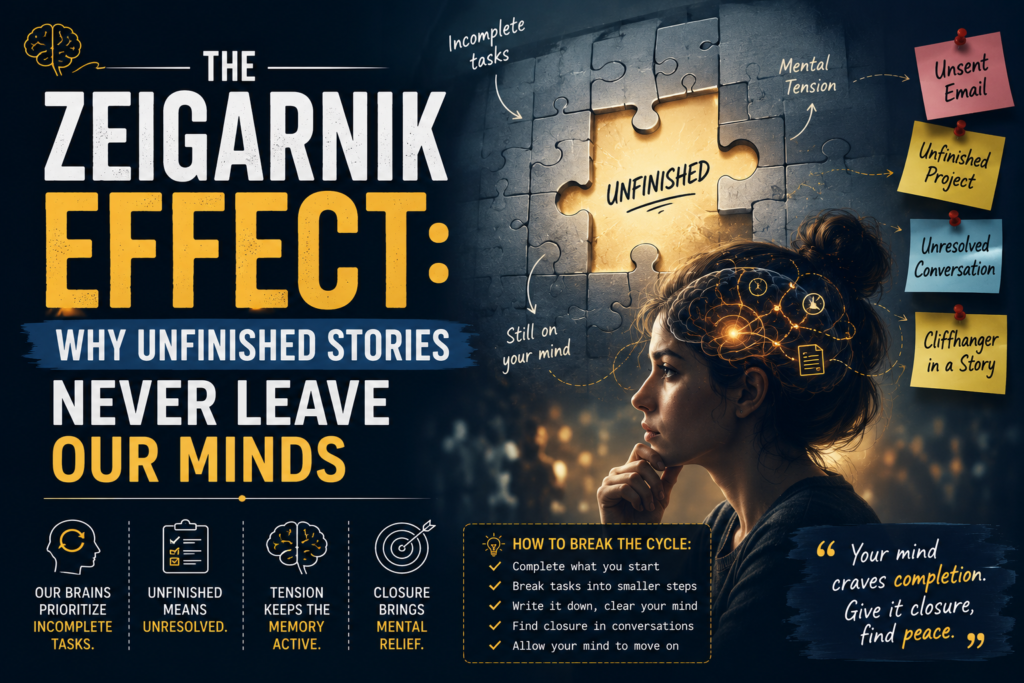
“Some stories end in the world. Others continue quietly inside our minds. “
Have you ever noticed how …
We humans forget ten completed conversations, yet remember the one text from someone close to us that simply says,
“We need to talk. “
without another reply.
That single text can occupy your mind for the complete day, leaving you wondering what the person was supposed to talk to you.
Imagine you are watching a web series and you decided to watch one episode only to realize that you completed the whole web series in one go.
This was due to the reason that your brain refuses to accept an unfinished story.
Actually “ The human mind seeks closure the way the ocean seeks the shore.”
We often find ourselves blaming for overthinking.
For replaying conversations.
For worrying about unfinished assignments.
But what if I told you …
Your brain was designed this way?
Psychology has a name for this invisible tug that unfinished things have on us.
It’s called the Zeigarnik Effect.
And once you understand it, you’ll never look at unfinished tasks-or unfinished relationships-the same way again.
What exactly is the Zeigarnik Effect?
The Zeigarnik effect is the tendency of our brain to remember unfinished or interrupted tasks better than completed ones.
In simple words, whenever we start something but don’t finish it, our brain keeps it mentally active.
Think of your mind as someone waiting for that one reply after the text “we need to talk.”
Until the reply arrives, your brain refuses to let the conversation go.
The same happens with unfinished assignments, unread books, unanswered emails, and even unresolved emotions.
Imagine another situation where a relationship end without any explanation. No final conversation. No chance to ask ‘why?’ or say ‘I wish things had been different. ‘ Days turn into weeks, yet your mind keeps replaying memories, imagining different endings, and searching for answers.
Psychologists suggest that one reason this happens is the Zeigarnik effect. Our minds naturally seek closure. When a significant emotional chapter ends without resolution, it can remain mentally active, making it harder to let go
Why Does The Brain Do So?
“ Imagine spending hours solving a 1,000- piece jigsaw puzzle, only to discover that one piece is missing.”
You immediately don’t admire those 999 pieces you own and completed.
Your eyes go straight to the empty space.
That tiny piece suddenly becomes the most important part of the puzzle.
Our brain works in much similar way. It naturally focuses on what’s incomplete, searching for the missing piece until the picture finally feels whole.
Psychologists believe that this happens because unfinished tasks create psychological tension. Once we make a commitment to a goal, our brain directs attention and mental effort to accomplish it. When that goal is interrupted, the tension doesn’t simply disappear- it lingers, making the task easier to remember and harder to ignore.
The Story Behind the Zeigarnik Effect
“ some of psychology’s greatest discoveries didn’t begin in a laboratory. They began with simple observations.”
It was the 1920s.
A young Soviet psychologist named Bluma Zeigarnik was sitting in a busy restaurant in Berlin with her mentor, Kurt Lewin.
As waiters hurried from one table to another, something unusual caught her attention.
As the waiters were completely occupied by so many customers, the waiters effortlessly remembered every unpaid order- who had ordered which cuisine, which table want a dessert and whose bill was still pending.
Zeigarnik noticed something unusual and out of curiosity she decided to test the waiters.
She approached one of the waiters and asked him to recall an order that has already been paid for.
To her surprise, the waiter struggled to remember the order details.
This led to a conclusion, by Zeigarnik that the moment the order is complete and paid it felt like the details of the order vanishes in a blink of eye.
Why?
That simple question lands us to the most fascinating discoveries of psychology.
After observing all this, Zeigarnik designed an experiment.
She asked various participants to complete a series of activities- arranging blocks and performing small tasks.
Some participants were allowed to finish every task.
Others were intentionally interrupted before they could complete the task.
Later when all the participants were asked to recall the activities, something astonishing happened.
The participants remembered the interrupted tasks nearly twice as well as the completed ones.
Their minds held onto what remained unfinished.
This observation became known as the Zeigarnik effect- the tendency of our brains to remember unfinished or interrupted tasks better than those we have completed.
The Science Behind the Zeigarnik Effect
“ The mind rarely lingers on what is complete; it lingers on what still seeks an ending.”
Psychologists believe it all comes down to psychological tension.
The moment we begin a task, our brain creates a mental goal. It allocates attention, energy and memory to help us achieve it. As long as the goal remains unfinished, our brain considers it “ still active.”
Think of it like a movie you’ve paused halfway through.
Even after switching off the television, a part of your mind keeps wondering.
“ What happens next?”
Similarly when an assignment is left incomplete, a conversation remains unresolved, or a relationship ends without closure, the brain continues to revisit it- not because it enjoys overthinking, but because it is still searching for an ending.
How Can You Use the Zeigarnik Effect Positively?
The Zeigarnik effect isn’t just an interesting psychological phenomenon- it can also become one of your greatest productivity tools.
- Start before you feel ready.
Many people keep on waiting for the motivation before starting a task. Ironically, motivation often appears after you begin.
For example, you are not getting the motivation to start a new lesson, but if you try and study for 5 minutes it creates an open loop in your mind and it brings hope to your mind that you will return and finish the task later.
- Write down your thoughts.
Making a to-do list of your work is like a promise to the brain that nothing important will be missed and every task will be given equal importance.
You will start feeling relaxed after writing down all the work because now your brain has not to carry the burden of remembering every unfinished task.
It knows that there is a system that will be working to keep all tasks in place.
- Give yourself closure
Not everything in life receives a perfect ending.
Sometimes closure comes from accepting that not every question will have an answer.
Learning to create your own closure can be one of the healthiest ways to move forward.
- Don’t leave too many “open loops”
One unfinished task is motivating.
Twenty unfinished tasks become mentally exhausting.
Try completing small pending tasks regularly instead of allowing them to pile up.
Your mind will thank you.
The Stories We Carry
Long after the world has moved on, our brains quietly revisit unfinished chapters.
A dream we abandoned.
A message we never received.
A goodbye that never felt coming our way.
Perhaps that’s what makes us human.
We are creatures who remember not only what happened, but also what almost happened.
The Zeigarnik effect reminds us that unfinished stories have a remarkable way of staying with us.
Yet it also reminds us that healing doesn’t always begin with finding the perfect ending.
Sometimes, healing starts when we know that our peace is worth more than the answers we’re still waiting for.
“Some stories stay with us forever- not because they never ended, but because they changed who we became.”
Really enjoyed reading this! Your writing is engaging, informative, and easy to follow. Great work!
👏👏
Such a wonderful and inspiring thought! 🌸✨ These words remind us that consistency, hard work, and a positive mindset are the true keys to success. Thank you for sharing such a meaningful message. Keep inspiring everyone! 🙏💯
Well done.
Very interesting topic.
Well explained 🥷🏼
Great work! Keep inspiring everyone with your words.
Very well done….
Good job 👏🏻👏🏻
Grt.work..Keep going 👌
Mehak I loved the way you expressed the concept of zeigarnik effect with real life examples..
I love your way of expressing thoughts 👍
Well explained
Usage of Zeigarnik effect positively is great…well elaborated..one can resonate all those points with their own life..worth reading ideas dear Mehak…keep on touching each and everyones life with your precious words ✨💯
Keep it up
Wonder and amazing knowledge
Very informative and realistic.. Keep it up. You r star of our family. The sky is the limit.. Well done mehak
Well explained
Very informative