
“ The strongest cages are rarely made from steel; they are forged from the fears we carry within”
INTRODUCTION
The room is silent. The walls haven’t moved. Nothing dangerous is present. Yet your heart races, your palms sweat, and every second feels heavier than the last. For someone living with koinophobia, this experience is not imagination-it’s reality.
For individuals experiencing Koinophobia, the fear of enclosed spaces is genuine. For them a place which provide comfort to other individuals may become a place which may trigger discomfort, anxiety, or an urgent desire to escape.
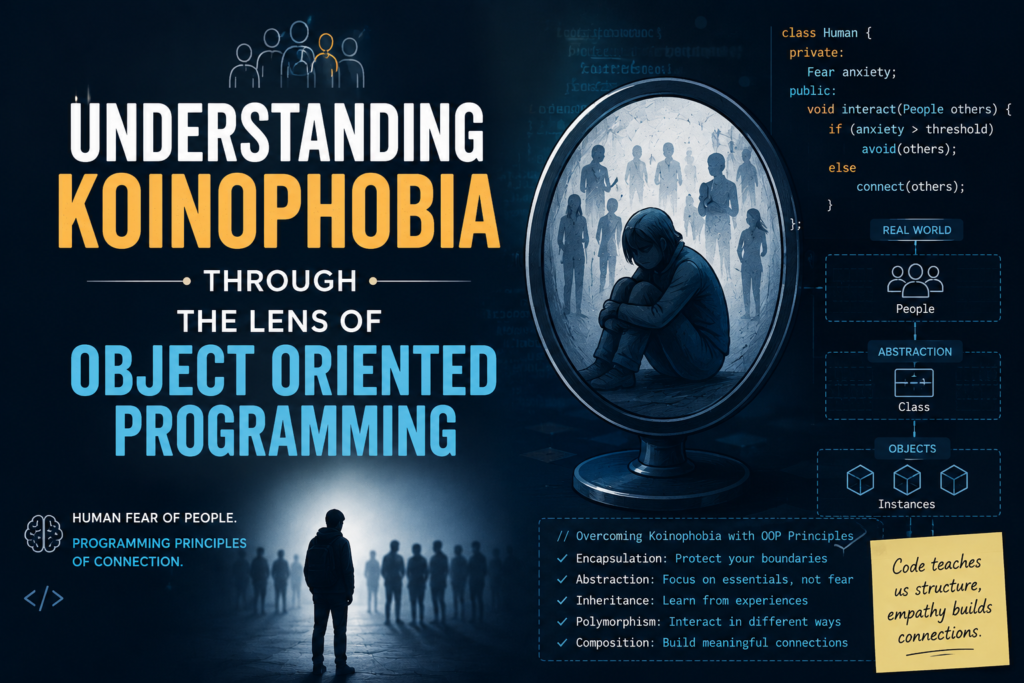
As this fear looks fascinating from psychological perspective, I will take you with me to look from another perspective: the four pillars of object oriented programming (OOPS)
While some of you may feel that programming and psychology both are unrelatable to each other but at the same time both deal with complex structures. One with that of software and the other one with the human beings.
Let’s begin this journey into Koinophobia with the help of Encapsulation, Inheritance, Polymorphism and Abstraction.
What is Koinophobia?
Koinophobia is an intense fear associated with enclosed environments. Unlike ordinary discomfort, this fear can provoke significant emotional and physical reactions.
Common symptoms may include:
- Increased heart rate
- Sweating
- Dizziness
- Difficulty breathing
- Strong desire to leave the place
- Panic attacks in severe cases.
To an observer it may appear irrational. However for an individual experiencing it, the fear is very real.
“ Fear is a storyteller; it takes ordinary moments and rewrites them as dangers.”
Pillar 1: Encapsulation- The Hidden Fear Within
In object- oriented programming, Encapsulation refers to hiding internal details while exposing out what is necessary.
Similarly, people experiencing koinophobia often conceal their struggles from the outside world.
Just as data remains hidden inside an object and can only be accessed through specific methods, fear often remains hidden behind smiles, conversations and daily routines.
Human emotions often resemble a perfume bottle. As long as the bottle remains intact, its fragrance stays contained. But when it breaks, the fragrance spreads everywhere.
The same can happen with fear. A person may hide anxiety for months, or even years, but when emotional pressure becomes too great, the fear may suddenly become visible through panic attacks, avoidance behaviors or overwhelming distress.
Because “ when a perfume bottle breaks, you smell it stronger than ever, but it’s the last time you will ever smell it.”
Sometimes our strongest emotional reactions are not signs of weakness-they are signs that something hidden has finally surfaced.
Pillar 2: Inheritance – Where Does The Fear come From?
In OOPS, inheritance allows one class to acquire properties and behaviors from another.
Similarly, fears often originate from previous experiences, learned behaviors, and environmental influences.
A person who once touched a hot stove learns to associate the stove with pain. Similarly, someone who experiences panic in an enclosed room may later associate all similar spaces with danger.
The brain carries forward the emotional properties of that experience into future situations.
“ what once protected us from pain can eventually prevent us from experiencing growth”
Pillar 3: Polymorphism- Different Minds, Different Responses
One of the most fascinating principles of OOPS is Polymorphism, where the same action produces different outcomes depending on the object involved.
The same principle we can observe in human psychology.
Imagine you are entering into a GD round of a recruitment process and you find there ten people.
The room doesn’t change yet each person sitting in the room experience different emotions.
Person A feels comfortable and relaxed. Person B feels slightly uninterested. Person C feels excited about the opportunity coming ahead. Now when we talk about person D experiencing Koinophobia feels trapped, anxious and desperate to leave.
From this example I just want to deliver a message that even the room is identical for all four persons yet the response of every person differs.
This brings me to a conclusion that
“Reality is not only shaped by circumstances; it is shaped by perception.”
So now you might be thinking why each person reacted differently. They reacted differently because of personal experiences, memories, previous conditioning.
Just as objects in OOPS respond differently to the same method call, individuals respond differently to the same environment.
Pillar 4: Abstraction- What we see VS What we Don’t
In OOPS, Abstraction involves displaying essential information while underlying complexity.
Human behavior operates in remarkably similar way.
Every day we see people laughing, working, studying, and interacting with the world. We see their actions, hear their words, and observe their decisions. But what we witness is just fraction of their reality.
A student leaving the classroom suddenly. The teacher may think the student is uninterested and rude. Friends may assume boredom.
After having so many point of views, it may happen that none of them may be true.
What remains hidden may be countless thoughts, emotions, fears operating in an individual’s mind.
For someone experiencing koinophobia, leaving a room may not be a choice- but a battle between staying and the hit of overwhelming anxiety.
The world often judges a person without understanding the story behind it.
We just rarely hear the fears.
This is where abstraction comes to existence.
Just as a programmer doesn’t need to understand every single line of code, similarly we often interact with people without understanding the complexity of experiences shaping their behavior.
“ the deepest parts of a person are often hidden behind the simplest actions”
At first glance, object-oriented programming and psychology seem to belong to different worlds.
Yet both attempt to answer the same question:
Why does a system behave the way it does?
The human mind can be understood, supported and healed because every reaction has a reason hidden beneath the surface.
“the goal is not to eliminate the fear, but to understand it so deeply that it no longer control the way we live.”
unique idea.
Thank you for sharing valuable information
Wonderful information.. great work… Kuddos
Helpful
Wonderful work 👏🏻
Great
Valuable Information
The way of explaining is excellent.
Really good job… I would like to say that your words are truly an eye opener for those people who don’t want to understand that some individuals have hidden struggles that you have described well…dear keep it up
So good 👏👏
Keep it up bro
Mehak, your way of spreading your thoughts is very impressive.
Wonderful ideas. Keep it up.
Good job done
Keep going 👍
Good information
Well explained…..keep doing